Suddenly Unhyphenated
In May 2018 I learned that the racial identities you’re given at home don’t always travel with you when you go abroad. I experienced the best three weeks of my life while studying abroad in Austria, but also a confusing and unexpected loss of identity while there. Going abroad included a lot of new things for me such as: my first flight ever, my first train ride, my first time being in a new time zone (Chicago doesn’t count), and my first time making friends who shared both my love for classical music and my sense of humor. However, in addition to all of these fun firsts, I knew that going to Europe would mean a new first that I wasn’t excited to experience: being one of very few Black people in a majority White space. Technically that’s not a new experience for me, but it’s different knowing that Black people exist nearby, simply out of my sight, rather than having no idea if anyone who looks like me lives in that country. In the event of a surprise race war, I need to know who would have my back. As the only Black person as far as my eye could see, on the continent that White people came from, I was outnumbered.
Even though I was nervous about potentially being the only Black person in Austria, I was still overjoyed about going. I have lived in Michigan for most of my life, but I’ve always had a strong desire to travel. For a very long time it felt like I would never be able to achieve that goal, because I grew up in a single parent family within a poor community, so affording a flight had always been out of the question, let alone an entire trip. I was more than happy when I realized I could study abroad in spite of my unchanging socioeconomic status. Yet despite all of my excitement, the concern about the new racial situation I assumed I would have to face was ever-present. Would my presence in public spaces draw attention? Fortunately that hasn’t really happened to me much in the US, despite still being in the minority group. Whether the attention was positive (“Wow! We don’t see people of color too often!”) or negative (“Ew, what is she doing here?”) I knew I didn’t want it. I was also concerned about being the only Black person in my study abroad cohort of 16 people. I was, thankfully, not the only person of color in my group, but I was still the only one with brown skin so I was very concerned about sticking out. I was also concerned that if I did happen to experience some sort of racial hate, I wouldn’t be able to complain about it because none of them would understand. As a Black person, I’m fairly aware of my skin at all times, but as White people, they don’t have to remain consistently aware of the fact that they’re White. Even though I was used to being in situations where I was the only Black person, or one of few in the room, I was not excited for the hyperawareness that I felt I would experience in Europe.
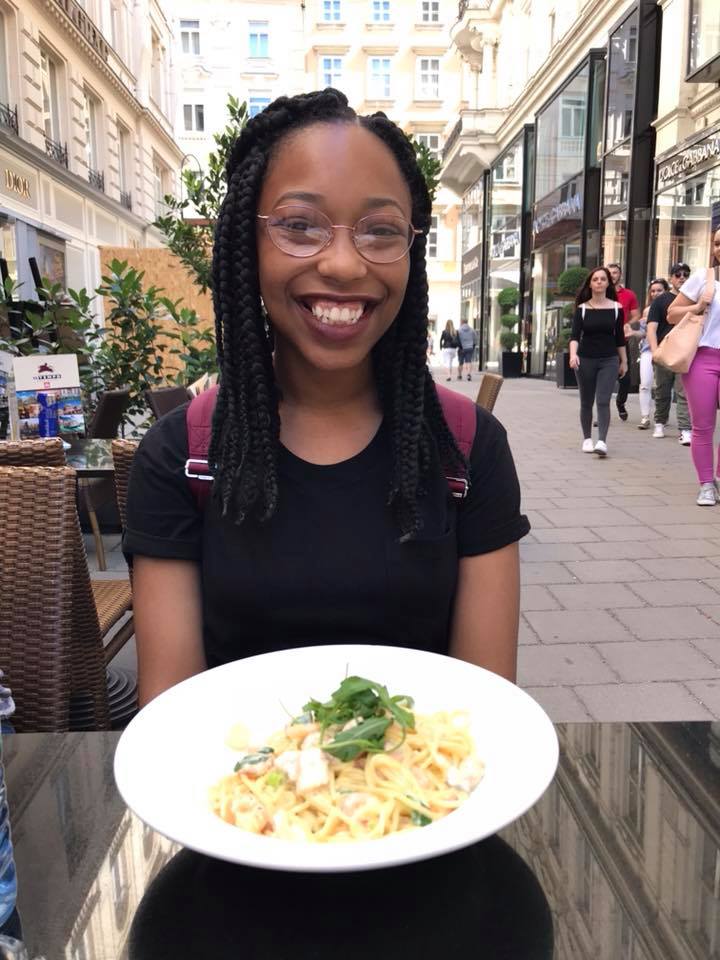
The first day or so into my study abroad experience, I did feel a little like I didn’t belong in Europe; I was met with a White face at every turn. I remember walking through Vienna, feeling a general sense of happiness and wonder at my surroundings but still feeling an undercurrent of uneasiness. As we walked down Kärntner Strasse, a popular street for shopping in Vienna, passing the State Opera House, gift shops, cafés, and gelato stands, all housed in dazzlingly ornate architecture, I wondered if people were looking at the group of us and thinking one of these things is not like the others. I’ve had a White friend say that to me once before, during high school. I was visibly different from my mostly White group of friends, and that friend’s boldness in pointing it out made me uncomfortable. To keep this from occurring in Vienna, I found myself consistently being the one to bring up the fact that I was Black. For example, one time we were walking around in a group of four girls and one guy and one person said to the guy “you’re the minority here!” and I said, “Actually, I am!” I knew she meant in terms of gender and not race but I felt like I had to point it out anyway.
In order to feel a little less alone, I kept an eye out for Black faces everywhere, and to my surprise I saw more than I expected. I was happy to see that more than just my own Black skin was in Vienna, but I still felt a bit different from the people I saw. In the United States, being part of the Black community can feel like being part of one giant family. I don’t have to know the other Black people in a space to feel that we are connected to one another, we just are. In Europe, it was very different. I had no idea where these Black people were from. Were they fellow Americans? Africans? Could they have been English? Instead of feeling like these Black faces in passing were close kin to me, I felt like they were distant cousins that I didn’t know existed until meeting them for the first time.
Over time, I began to feel raceless in Vienna. I know that doesn’t really make sense, because none of us exist without race, but that is sort of how I felt. It was akin to putting your hand in the dryer hours after your clothes have dried, and initially being unable to tell if the clothes are just cold, or are somehow still wet: you aren’t sure if you should be satisfied or not, and you aren’t even relieved once you realize the clothes were just cold because the momentary confusion was too strange to allow for that. In other words, I wasn’t sure if I should be relieved that for three weeks I wouldn’t have a target on my back full of American racial stereotypes, or if I should feel uneasy because being Black is such an important part of who I am that it was weird to have the American half of “African-American” take over my perceived identity.In Austria my new identifier, American, meant that I was loud, unable to speak German, and poorly dressed in comparison to the Austrians. As I acclimated to my new identifier, I began to feel like I was just one person in a group of 16 Americans exploring the city. The usual racial divides that I would have been more aware of in the United States between my peers and I slowly dissolved in Austria. Although on one level I still felt different from everyone else (because I am), I was surprisingly able to forget about that on most days during my three weeks abroad.
I didn’t expect to experience suddenly being hit with my Black identity again when I returned to the United States. Not that I lost it, but I felt it in a new way once I returned. I hadn’t given it much thought until one day in July when I hung out with some of my friends from study abroad in Detroit. Even though I had grown fairly comfortable with them in Vienna, in the context of a new city in our home country, I felt on edge, as if my hand was in the dryer again. I was walking around Detroit, a very Black city, with two White people. Suddenly, I found myself missing those three blissful weeks in Vienna when we were all unhyphenated Americans. Spending time with the same group of people in two different racial contexts created a stark contrast between our physical appearances in America, which melted away the sense of unity that I had felt among us in Europe. I felt a chasm grow between us that had not been there before. We were all still friends, and really nothing had changed, but now that we were in the United States everything felt entirely different. We were all Americans, but we weren’t. I was concerned that now that we were in America, with new racial roles, our friendships would end. I also felt incredibly uncomfortable knowing that other Black people could see me out and about with White people because I worried that it would communicate something about me that I wasn’t trying to say. Even though they were my friends, I was very concerned about potential judgment from onlookers. I didn’t want to be seen as someone who didn’t like being Black, because I had been accused of this before, many years earlier. I’d spent a little bit of time talking with them about race in Vienna, which let me know that they weren’t the kind of White people that would stupidly call me racist for bringing up any single issue that’s centered on race. Instead, they would listen to me, and learn.
Shaping My Black Identity
Interacting with the same group of people both in Austria and American caused me to think a lot more about how race has functioned throughout my life. I wondered how I had gotten to this point. I am often surrounded by lots of White people and have flipped back and forth between being unbothered and very bothered by that fact. I’ve always had mostly White friends, and I’m not entirely sure why. I think a lot of it could have to do with the classes I was placed into; from fourth grade onward I was in advanced classes, which unfortunately aren’t welcoming to minorities. Most classes I’ve ever been in have usually included mostly White students, and only a few Black students, usually less than 10. So it would make sense for that to have a big influence on whom I socialized with. Yet, prior to fourth grade, I still selected White friends often, and I really don’t know why. I know the number of Black students in my classes was higher before, because I definitely noticed the difference once I got to fourth grade, but I don’t know why I didn’t interact with the other Black students as often as I did the White students. That could just be the way that it happened. I remember not getting along too well with some of the other Black students, not because of anything in particular, we just didn’t click. But, I very much hope there was not an underlying racial barrier on my part. As a non-White kid, you learn that “White is right” pretty quickly. Thankfully I’ve unlearned that mentality in the years since then, but I wish I never had to learn it in the first place. I wonder if subconsciously I felt like choosing White friends would somehow bring me closer to being White, and therefore being “right”. On the other hand, I feel that it was not this, because outside of school I had Black friends, and being rejected by my Black peers at school was very difficult for me. I didn’t have anything against them, we just weren’t friends. But they read me differently; because all my friends were White, I was White too.
I remember one day in fourth grade, the whole class was lined up outside of my elementary school’s gym. I don’t think we were supposed to be talking in the line, but of course, we were anyway. A light skinned mixed boy standing next to me, Jaden, asked me what kind of music I liked to listen to. Not being very familiar with genre distinctions, I just said, “I’m not sure, a little of everything I guess. Rock maybe?” I learned that this was the wrong answer. Jaden said, “Oh so you like White people music”. That caught me off guard. White people music? Little did he know that I also knew all of the best rap and R&B songs of 2006 just like he did. My Mom played every. single. hit. song. and when she played music you could hear it down the block. There was no way that I could have escaped the music if I’d wanted to, but Jaden knew none of this. I hated that somehow the music I liked personally was wrong and somehow took some of my Black identity away from me. The following year in fifth grade, Jaden was a second time offender. That school year my best friends were two White girls, Haley and Katelyn, and an Asian girl, Marina. Jaden and Sierra (another Black student in my class) came up to me one day during class, very upset with me. Together, they were claiming that I only liked White people, because I always hung out with the White students (specifically my best friends of that year), and again implying that I wasn’t as Black as they were. I was deeply hurt by their accusation, and have carried this idea with me ever since then. I had done nothing wrong, but suddenly the two of them decided it was time to kick me out of the Black community. I wish that at the time I had realized that two ten-year-olds saying something didn’t make it true.
Throughout the years, fellow students kept insisting that I was White. In sixth grade my favorite bands were Paramore, Fall Out Boy, and My Chemical Romance. I guess that, plus maybe the way that I speak is what caused Tony, the boy who sat behind me in Beginning Band (he played trumpet, I played clarinet) to call me Oreo instead of Aarel, all of the time. I believe another boy (a saxophone, Jaren) had begun calling me this too. At first I was very confused by this nickname that I didn’t ask for, but they happily explained to me that it meant that I was White on the inside and Black on the outside. An important note here is that both Tony and Jaren were Black too. Despite the name calling, they were still otherwise friendly with me, so I doubt they meant any actual harm by it. It can be difficult to realize the impact of what you or others say when you’re only eleven. I remember the “Aarel’s an Oreo” idea spreading, with more and more people finding that statement to be entertaining and accurate. I wasn’t a fan of this nickname, but I wasn’t hurt by it, just annoyed. Even though it didn’t seem to be a big deal at the time, the act of nicknaming me an Oreo further served to alienate me from my Black peers, I just didn’t fully realize that that was happening at the time.
As time passed and I got older, the “Aarel’s an Oreo” thing didn’t bother me as much anymore. By seventh grade I had switched from being slightly uncomfortable with being Black in White spaces, to not noticing it much at all. This was a few years deep into mainly White friendships, and I hadn’t noticed much of an issue within any of those friendships. I was convinced that we were in a post-racial society and that it was my wiser and more experienced Mom and Grandma who had the wrong ideas about race. My rationale at the time was that because they hadn’t met my friends, they didn’t understand that modern White people were nicer than White people of the past. I was still in band, which was about 90% White, and that was the source of my “super nice White friends”. However, one weird microaggression happened during band one day. Two bandmates, Catherine and Elise, were talking to my friend Larenzo and I one day in my band teacher’s office. I can’t remember why we were in there without him, but anyway, the topic of race had come up. Catherine and Elise proudly told Larenzo and I that we were the Whitest Black people that they knew. A few other people in the band said this to me throughout middle school. I hate that at the time I took this as a compliment. I didn’t know enough about how race worked in society at that point to understand that what they said was actually insulting. Yet in their defense, I doubt they knew either. They were implying that the way I spoke, the things I liked, and maybe just the way I acted in general was more in line with Whiteness than Blackness. All of the things they enjoyed about me needed to be paired with the term “White” instead of “Black”. This line of thinking sets up a good and bad dichotomy between being White and being Black. I am ashamed that their acceptance of me made me feel as if I was “one of the good ones”; an exemplar of my race. I have changed so much since then that this is very uncomfortable to type. Regardless of how I felt about being “the chosen Black”, I never had anything against any of the other Black students. I think it’s just that with everyone calling me White, I felt alienated by everyone else who was like me. I needed to fit in with someone, and everyone had decided that my rightful place was the White people.
By the following school year I had grown less comfortable with being the only Black girl amongst my friends. I hated being questioned about why my hair felt the way that it did. I may have put too much product in it, causing it to feel a little greasy BECAUSE of the product, but that’s far different from the oil that is produced by White people’s heads when they haven’t washed their hair in 48 hours. Our hair does not work the same and I was tired of having to explain that to people while they looked at me as if there was something wrong with me. In ninth grade I posted a status about feeling odd having so many White friends. I ended the status with “not trying to be racist” which is actually laughable now. I don’t even have the social power to be racist, especially against White people. I had wished for more Black friends, but since Jaden and Sierra kicked me out of the community back in fifth grade, I felt that it was too late to come back. Not that I truly ever left it, but I certainly believed that I wasn’t welcome; I was too White for Black students. I still feel like this sometimes even now. I knew very few Black students at the University of Michigan during my time there. The idea of getting to know them was already daunting because of social anxiety, but also because I feared that they would reject me. After being told that I wasn’t Black enough for several years, it has been very difficult to rid myself of something that I have internalized.
Throughout most of high school I remained on the “I wish I wasn’t the only Black girl in my life” side of things. I oscillated between feeling at times too Black for my White friends, and feeling like I wasn’t Black enough for everyone else. In both realms, White and Black, I felt that I would always be last in terms of friendships and relationships. Why would new White people befriend me when I was Black? Why would any new Black people befriend me if I was so different from them? Why would a White guy look at me twice when there were White girls for him to talk to instead? Would Black guys EVER like me? They like Black girls, they like White girls, but they don’t like “Oreo girls”. I was frustrated with who I was. I just wanted to feel like I was Black enough. I wanted to feel like all of my interests and attributes contained within a Black body was okay. I was hyperaware of how different I was, and I just wanted to be myself in peace.
My Awakening
In high school, it took well publicized acts of police brutality for me to fully realize that racism was alive and well, and that my Mom and Grandma had been right. George Zimmerman killed Trayvon Martin because he was Black. Darren Wilson killed Michael Brown because he was Black. It was their Blackness, and nothing else, that made these two teens a threat in the eyes of grown men. I remember being outraged when Darren Wilson was not indicted, and on Twitter I was livid. This was my second time experiencing injustice within the justice system that was obviously racially motivated (remember when Zimmerman wasn’t found guilty at first?). I had plenty to say, and found that not everyone agreed with me. I was wrong for being upset about the clear-as-day racism that surrounded Brown’s murder. I was the racist for not pretending to be “colorblind”. It was ridiculous that I was disappointed with America when it failed me as a Black person. I lost friends and engaged in many online arguments from that day (November 24, 2014) forward. During this time I gained more strength in my Black identity because I was just as upset as everyone else who looked like me about police brutality. We cared and we were going to speak up about it. Among people from my hometown, I gained a reputation on social media as the girl who was going to stay on top of social political events involving race, and who had no issue telling you why you were wrong and racist.
In college, racist event after racist event happened (cough cough made worse by the rise of Trump cough) throughout the US and on campus. I participated in several protests, sometimes even going to them alone (not my greatest idea, I suggest not doing that). In a few classes I was able to learn more things about Black culture that I didn’t know, such as facts about Motown, or African-American history from the 1700s up until around the Civil Rights Movement. I felt Blacker than ever before. I had even gotten to a point where I was absolutely fed up with White people; if you take a walk down memory lane and think about the newfound intensity in the resurgence of open and unabashed racism, you’ll see why. After seeing the movie Get Out I thought oh no I need to be more careful. My attitude toward White people had become a lot less trusting, and I had far less concern for how they perceived me than I did when I was in elementary school. I was still very aware of my race, my Blackness, but I knew who I was. I knew that I was great because of the skin that I lived in everyday, not in spite of it. Additionally, I can now say that I know that I am American, too.
American, Too
Going to Vienna had a great impact on my interaction with the Black and American components of my identity. I think the most important thing I gained from my experience abroad is the realization that I exist in the world as both of these words:
Black.
And American.
But even as I write this, it’s still difficult to pin down what this all means; what the intersection of these two identities means for me, regardless of the context. Langston Hughes has a poem called “I, Too” in which he does a better job than me at saying that he’s an American in addition to being Black. I think this essay is about me being an American too or maybe realizing that I’m an American too. I know that doesn’t make a ton of sense, but do our identities really make sense anyway? Regardless, I think that’s what it’s about. And I want you to read Langston’s words now because he is another Black American writing in a different time, telling you the reader about how he, a Black man, is an American too and one day people will realize that he is, and I am a Black American, writing to you today, telling you about how I realized something similar to Langston.
Here is his poem. I think its presence sums up my essay:
I, too, sing America.
I am the darker brother.
They send me to eat in the kitchen
When company comes,
But I laugh,
And eat well,
And grow strong.
Tomorrow,
I’ll be at the table
When company comes.
Nobody’ll dare
Say to me,
“Eat in the kitchen,”
Then.
Besides,
They’ll see how beautiful I am
And be ashamed—
I, too, am America.
I have been and always will be American, whether someone can identify that by just looking at me or not, but in the United States it doesn’t always feel that way. White people are just American. There is no qualifier along with their name, yet everyone else gets one (African-American, Chinese-American, Indian-American, Native-American, etc.). Even though I’m just as American as any other American, it often seems that some White people believe that the United States is for them and them alone, and that they are the only true Americans. That line of thought is 100% flawed, but people who think that way exist, nonetheless.
Going from being very aware of my identity as a Black person to suddenly feeling raceless in Vienna was very strange, and I didn’t think I expected it to feel as liberating as it did. I am a proud Black American. I am happy that I’ve grown out of the phase where I wanted to be White. I love my curls, I love my culture, I love not getting sunburns. But being Black comes with difficulties too. As previously stated, we do not live in post-racial society. The racism that exists now is a product of the past. People think racism ended the exact second that the Civil Rights Movement ended, but that’s far from correct. It is still alive and well today, and many parts of American culture reek of it, and are rooted in it. The racist forces that have been built into American culture are what keep many minorities, like me, from ever truly feeling like Americans. Instead, we must jump through hoops and over hurdles to assert that we are American too. We have to learn how to navigate a world meant for White people to thrive in, not us. A lot of us also have to learn that we can like “White” things, while still fully maintaining our racial identities. Having my American identity overshadow my Black one while in Europe was weird because in America, despite being American, I am never afforded that opportunity.
Works Cited
Hughes, Langston. “I, Too”. poets.org, https://www.poets.org/poetsorg/poem/i-too. Accessed 11 March 2019.
 The Philosophy of Aarel
Great post 😁
LikeLiked by 1 person
Thank you so much!!
LikeLike
I love this so much Aarel, I think this speaks so much truth to the identity of black Americans. And as a mixed American myself I know how it feels to be “too white” for the black kids. I’m gonna be thinking about what you had to say with this post for awhile.
LikeLiked by 1 person